

CBTA explained
What is CBTA? Competency-Based Training and Assessment, in plain language.
Competency-Based Training and Assessment (CBTA) is training and assessment organised around defined competencies: what a person has to be able to do on the job, and the observable behaviours that show it. Performance is measured against a stated standard, not against hours completed. ICAO sets out the method in Doc 9868 (PANS-TRG), and it applies to pilots, cabin crew, air traffic controllers and maintenance staff. EBT is CBTA applied to recurrent pilot training.
Definition
CBTA in four terms. The words every CBTA programme is built from.
Competency
A dimension of human performance that is used to reliably predict successful performance on the job, such as communication or workload management. It shows in behaviours that draw on knowledge, skills and attitudes.
Observable behaviour
A single thing a person does or says that an instructor can see or hear, and that shows a competency. Observable behaviours are what is recorded during a session.
Competency standard and conditions
The level of performance that is acceptable, and the conditions under which it has to be shown. Together they say what "competent" means for a given role.
Assessment
Deciding, from the evidence gathered, whether the standard has been met for each competency. The grade follows from what was observed.
What changes
From hours and tasks to competence. Task-based training and CBTA, side by side.
A simplified comparison. The rules for each licence or approval define what a training organisation has to do.
What the course is built around
Task-based and hours-based training: A syllabus of tasks, with hours for each
Competency-based training and assessment: Competencies, with the standard to reach for each
What is assessed
Task-based and hours-based training: Each task, pass or fail
Competency-based training and assessment: Each competency, from the behaviours observed
When a trainee moves on
Task-based and hours-based training: When the hours are done and the test is passed
Competency-based training and assessment: When the standard is shown, with the evidence on record
What the instructor does
Task-based and hours-based training: Demonstrates, then checks
Competency-based training and assessment: Observes, records, classifies and assesses, then coaches on the root cause
What the organisation learns
Task-based and hours-based training: Pass rates
Competency-based training and assessment: Which competencies are strong or weak, per trainee, per course and per instructor
CBTA does not remove hours or tests where the rules require them. It adds a measured answer to the question the hours were standing in for: can this person do the job?
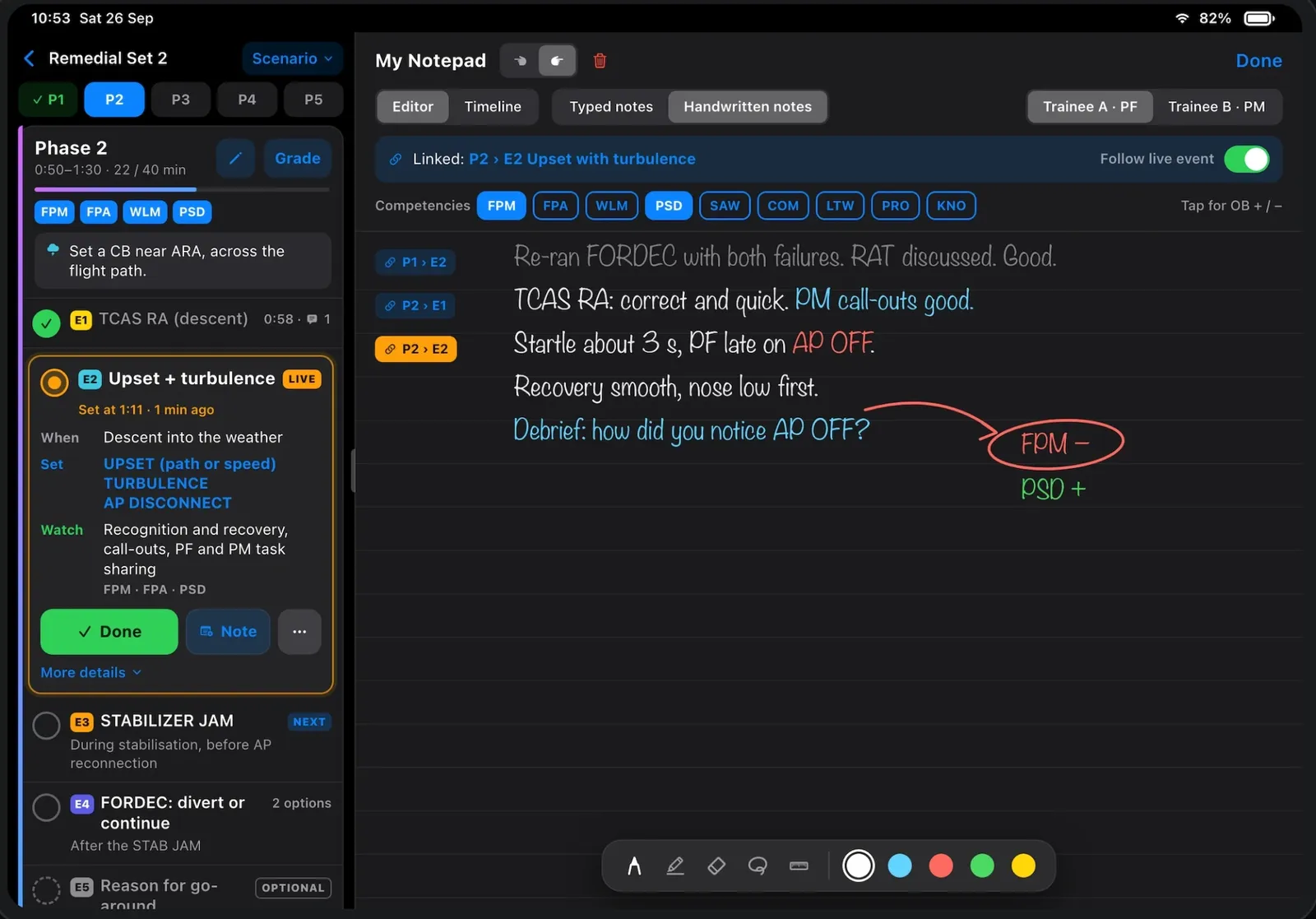
aeroEBT records each observation against the competency it shows, so the grade is stored with its evidence.
The instructor app in aeroEBT
The competency model
One framework, adapted to each role. From the ICAO competency framework to your own model.
ICAO publishes competency frameworks for aviation roles such as pilots, air traffic controllers and maintenance personnel. An organisation adapts the framework for its role to its own operation, and the result is its adapted competency model.
The ICAO competency framework
The competencies for a role, each with a description and its observable behaviours. It is generic on purpose.
The adapted competency model
The organisation's own version: the competencies, their descriptions and performance criteria for the role, with the standards and conditions that apply in its environment.
The training and assessment plan
What is trained, in which order, how each competency is assessed and what evidence is kept.
Where it applies
CBTA across aviation. The same method for the flight deck, the cabin, the tower and the hangar.
Airline pilots: EBT
Recurrent training in the simulator as Evidence-Based Training, under ICAO Doc 9995 and, in Europe, ORO.FC.231.
Learn moreFlight schools and ATOs
Competencies followed from the first lesson, so the airline receives a pilot whose record it can read.
Learn moreMPL cadets
The multi-crew pilot licence is a competency-based course from the start, in the terms of ICAO Doc 9868.
Learn moreCabin crew
Initial, recurrent and safety and emergency procedures training assessed against observable competence.
Learn moreAir traffic controllers
Implementing Regulation (EU) 2025/2143 writes CBTA into the European controller licensing rules, applying from 1 January 2029.
Learn moreAircraft maintenance
ICAO Doc 10098 applies CBTA to aircraft maintenance personnel: competence assessed at the aircraft.
Learn more
The rules
Where CBTA is written down. The documents a training organisation and its authority work from.
ICAO Doc 9868 (PANS-TRG)
Procedures for Air Navigation Services, Training: the definitions, the competency frameworks and the way a competency-based programme is designed.
ICAO Doc 9995
The Manual of Evidence-based Training: CBTA applied to the recurrent training of airline pilots.
ICAO Doc 10098
The Manual on Competency-based Training and Assessment for Aircraft Maintenance Personnel.
European rules
ORO.FC.231 for baseline EBT, and Regulation (EU) 2015/340 as amended by Implementing Regulation (EU) 2025/2143 for air traffic controllers. Your competent authority decides what applies to your organisation.
Questions about CBTA
What does CBTA stand for?
Competency-Based Training and Assessment: training and assessment organised around defined competencies and observable behaviours, with performance measured against a stated standard. ICAO sets out the method in Doc 9868, PANS-TRG.
What is the difference between CBTA and EBT?
CBTA is the method and applies to many roles. EBT, Evidence-Based Training, is CBTA applied to the recurrent training of airline pilots, with the training topics set from operational data. Every EBT programme is a CBTA programme.
What is a competency?
In ICAO's terms, a dimension of human performance that is used to reliably predict successful performance on the job. A competency shows in observable behaviours that draw on knowledge, skills and attitudes.
What is an adapted competency model?
The ICAO term for the group of competencies, with their descriptions and performance criteria, that an organisation adapts from an ICAO competency framework and uses to build competency-based training and assessment for a given role.
Who does CBTA apply to?
Pilots, cabin crew, air traffic controllers and aircraft maintenance personnel, among others. For airline pilots in recurrent training it takes the form of EBT.
How is a trainee graded in CBTA?
The instructor records what the trainee does, relates each observation to a competency and assesses each competency against its standard. The organisation sets the grading scale; for pilot EBT, EASA's guidance prefers a scale of 1 to 5.
Is there software for CBTA?
Yes. aeroEBT, from SkyDynamics, is software for EBT and CBTA, configured per role: pilots, cabin crew, air traffic controllers and maintenance training organisations each work with their own competencies, behaviours, grading scale and forms in one record.
Which documents is this page based on?
ICAO Doc 9868, PANS-TRG. ICAO Doc 9995, Manual of Evidence-based Training. ICAO Doc 10098 for aircraft maintenance personnel. Regulation (EU) 2015/340 as amended by Implementing Regulation (EU) 2025/2143 for air traffic controllers. This page is a plain-language summary: it does not replace them, or your authority's decision.
See CBTA running in one system.
A 30-minute demo covers your competency model, assessment on a tablet and the record your authority asks for.
We respond within one business day.