

EBT explained
What is EBT? Evidence-Based Training for airline pilots, in plain language.
Evidence-Based Training (EBT) is recurrent training and assessment for airline pilots, flown in a simulator and built on data. It develops and assesses a set of pilot competencies instead of repeating a fixed list of manoeuvres. The reference is ICAO Doc 9995, and in Europe baseline EBT is implemented under ORO.FC.231. EBT is the form that CBTA takes in recurrent pilot training.
Definition
EBT in four sentences. What it is, where it came from and who it is for.
What it is
Assessment and training based on operational data, which develops and assesses the overall capability of a pilot across a range of competencies, instead of measuring performance in individual events or manoeuvres.
Why it exists
Aircraft have become far more reliable, yet accidents still happen with nothing wrong with the aircraft. Accident and incident reports and flight data show the risks crews actually meet, so EBT trains for those risks and develops competencies that let a pilot handle the unexpected.
Who it is for
Pilots of commercial air transport aeroplanes in their recurrent training, in a flight simulation training device (FSTD). The operator runs the programme and its authority approves it.
How it relates to CBTA
EBT is competency-based training and assessment (CBTA) applied to recurrent pilot training. CBTA is the method; EBT is one programme built with it.
What changes
From checking events to developing competencies. Traditional recurrent training and EBT, side by side.
A simplified comparison. Your authority's rules and your approval define what applies to your operation.
What is assessed
Traditional recurrent training and checking: A list of manoeuvres and events, each flown to a tolerance
Evidence-Based Training: The pilot's competencies, shown across the whole session
Where the content comes from
Traditional recurrent training and checking: A set list of manoeuvres and events, largely the same from one check to the next
Evidence-Based Training: Assessment and training topics set from data, by aircraft generation
What the instructor does
Traditional recurrent training and checking: Checks each item against its standard
Evidence-Based Training: Observes, records, classifies and assesses, then finds the root cause with the pilot
The result
Traditional recurrent training and checking: Pass or fail, item by item
Evidence-Based Training: A grade for each competency, with the behaviours that support it
What the operator learns
Traditional recurrent training and checking: Who passed
Evidence-Based Training: Which competencies are strong or weak, across the pilot group
What happens next
Traditional recurrent training and checking: The same list next time
Evidence-Based Training: Training in the same module, and a programme that follows the evidence
EBT does not remove the standard a pilot has to meet. It changes what is measured and what the result is used for.
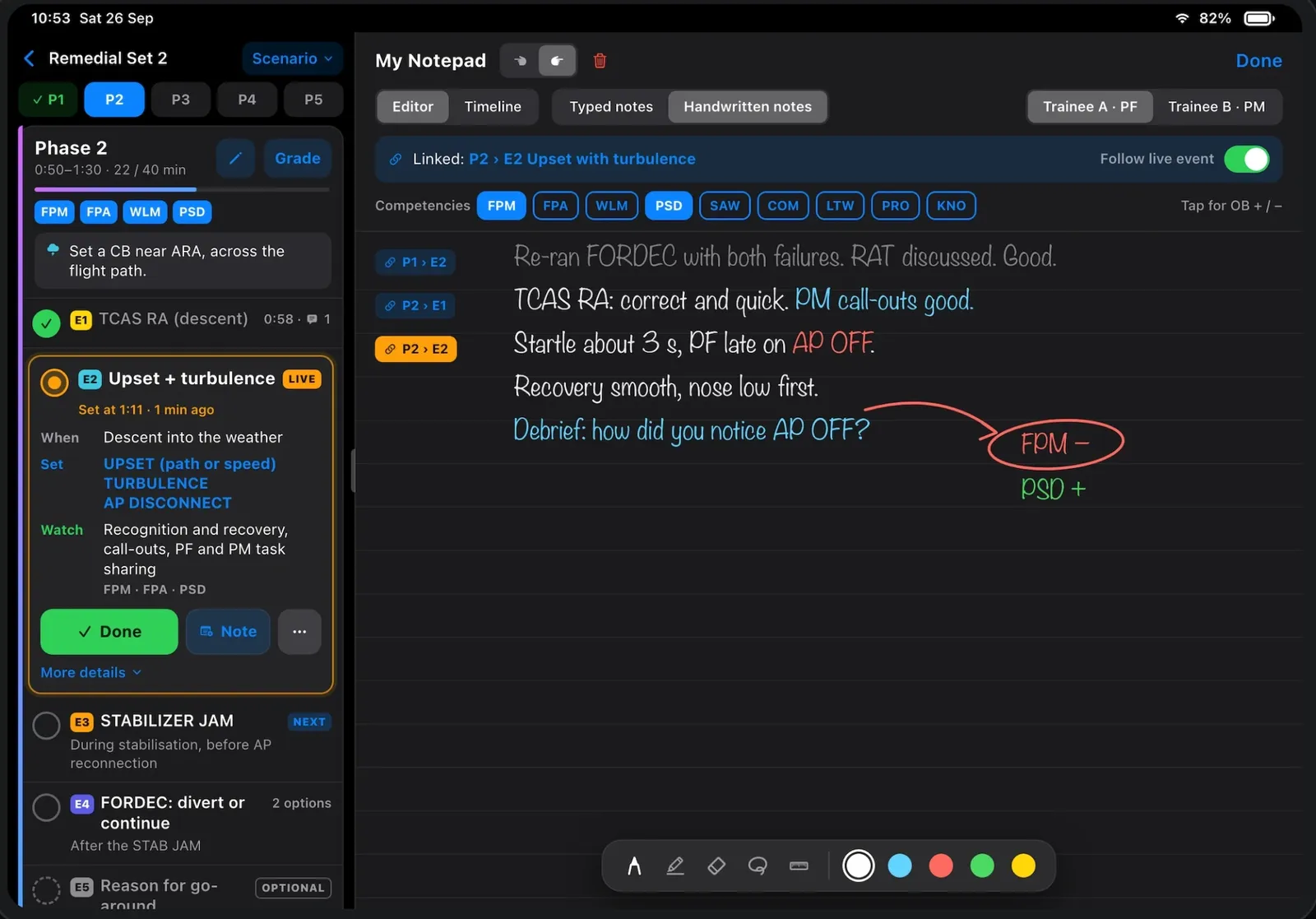
In aeroEBT the instructor follows this method on an iPad in the simulator, and each grade is stored with the observations behind it.
The instructor app in aeroEBT
Competencies
Nine pilot competencies. What an EBT instructor grades, in the EASA framework.
Each competency has a description and a list of observable behaviours: what an instructor can see and hear that shows it. ICAO Doc 9995 lists eight competencies; EASA added application of knowledge as a ninth.
Application of knowledge (KNO)
Knowing and understanding the relevant information, operating instructions, aircraft systems and operating environment.
Application of procedures and compliance with regulations (PRO)
Identifying and applying the right procedure, in line with the published operating instructions and the applicable rules.
Communication (COM)
Communicating clearly and effectively, in normal and non-normal situations.
Aeroplane flight path management, automation (FPA)
Controlling the flight path through the automation.
Aeroplane flight path management, manual control (FPM)
Controlling the flight path by hand.
Leadership and teamwork (LTW)
Influencing others towards a shared purpose, and working together to reach the crew's goals.
Problem solving and decision-making (PSD)
Spotting the first signs of a problem, containing it and deciding what to do.
Situation awareness and management of information (SAW)
Perceiving, understanding and managing information, and anticipating its effect on the operation.
Workload management (WLM)
Keeping capacity in hand by prioritising tasks and sharing them out, using the resources available.
The module
One EBT module, three phases. Evaluate, train the manoeuvres, train in scenarios.
An EBT programme is delivered in modules, flown in the simulator. Each module has three phases, in this order.
Evaluation phase
The first look at each pilot's competencies, to find their training needs. Anything below the minimum standard becomes the focus of the rest of the module.
Manoeuvres training phase
Practice of handling skills, not in real time: the simulator is repositioned so the crew can repeat a manoeuvre and improve it.
Scenario-based training phase
The largest phase: real-time, line-oriented scenarios that develop the competencies and train for the most critical risks of the aircraft generation, including threats and errors.
Mixed, baseline, enhanced
Three forms of EBT. Most operators move through them in this order.
Mixed EBT
Part of recurrent training and assessment follows EBT, while some of the traditional checks remain. A phased way in, while instructors and pilots learn the method.
Learn moreBaseline EBT
An approved EBT programme takes the place of the traditional recurrent training and checking. The operator follows the published programme for its aircraft generation, set in its own operation.
Learn moreEnhanced EBT
As ICAO Doc 9995 describes it, the programme itself is developed with the operator's own training data and safety data. Ask your authority what applies to you today.
Learn more
The rules
Where EBT is written down. The documents an operator and its authority work from.
ICAO Doc 9995
The Manual of Evidence-based Training: the international reference for the method, the training topics by aircraft generation and the baseline and enhanced programmes.
ICAO Doc 9868 (PANS-TRG)
Procedures for Air Navigation Services, Training: the international provisions on competency-based training and assessment, which EBT applies.
ORO.FC.231 and ORO.FC.232
The European rules for baseline EBT, introduced by Regulation (EU) 2020/2036. ORO.FC.231 covers the programme, the competency framework, instructor concordance and the grading system; ORO.FC.232 the assessment and training topics.
Your competent authority
The EBT programme is approved for the operator by its competent authority. Software, simulators and consultants support the programme; the approval belongs to the operator.
In practice
What an operator has to get right. The guides for each part of the work.
Scenarios
Built from the training topics and your own safety data, with coverage checked as they are written.
Learn moreInstructor concordance
Whether instructors grade the same performance the same way: the prerequisite most programmes underestimate.
Learn moreFrom mixed to baseline EBT
Prerequisites, five phases and the points where programmes stall.
Learn moreFrom baseline to enhanced EBT
Training from your own evidence, and what the rules allow today.
Learn moreFor Heads of Training
The programme, the standard, the evidence and the cost, from the programme owner's seat.
Learn moreaeroEBT
The EBT and CBTA software from SkyDynamics: scenarios, grading on an iPad, concordance and the record.
Learn more
Questions about EBT
What does EBT stand for in aviation?
Evidence-Based Training. It is recurrent training and assessment for airline pilots that develops and assesses competencies using data from operations and training, instead of repeating a fixed list of manoeuvres. The international reference is ICAO Doc 9995.
What is the difference between EBT and CBTA?
CBTA, competency-based training and assessment, is the method: training and assessment built around defined competencies. EBT is that method applied to the recurrent training of airline pilots, with the content set from data. Every EBT programme is a CBTA programme; not every CBTA programme is EBT.
How many competencies are there in EBT?
Nine in the EASA framework: application of knowledge, application of procedures and compliance with regulations, communication, aeroplane flight path management (automation), aeroplane flight path management (manual control), leadership and teamwork, problem solving and decision-making, situation awareness and management of information, and workload management. ICAO Doc 9995 lists eight; EASA added application of knowledge.
What are the phases of an EBT module?
Three: the evaluation phase, the manoeuvres training phase and the scenario-based training phase.
Is EBT mandatory?
No. Under the EU rules an operator may replace the recurrent training and checking of ORO.FC.230 with an EBT programme approved by its competent authority. It is the operator's choice.
Does EBT replace the proficiency check?
Under baseline EBT, the approved EBT programme takes the place of the recurrent training and checking of ORO.FC.230, which includes the operator proficiency check. Under mixed EBT part of recurrent training follows EBT and the checks remain.
What is ORCA?
Observe, record, classify, assess: the four steps an instructor works through in an evidence-based session. The debrief follows them.
Is there software for EBT?
Yes. aeroEBT, from SkyDynamics, is software for EBT and CBTA: scenarios designed in the EBT Scenario Builder, grading on an iPad that works offline in the simulator, instructor concordance measured from the grades already entered, and the reports for the authority from the live record.
Which documents is this page based on?
ICAO Doc 9995, Manual of Evidence-based Training. ICAO Doc 9868, PANS-TRG. Regulation (EU) 2020/2036, with ORO.FC.231 and ORO.FC.232 and their AMC and GM. The EASA EBT Manual. EASA Opinion 08/2019, on why EBT was introduced. This page is a plain-language summary: it does not replace them, or your authority's approval.
See EBT running in one system.
A 30-minute demo covers scenarios, grading in the simulator, concordance and the evidence your authority asks for.
We respond within one business day.