

EBT and CBTA
EBT vs CBTA. One is the method, the other is a programme built with it.
CBTA (Competency-Based Training and Assessment) is a way of designing training: around competencies, with performance measured against a standard. EBT (Evidence-Based Training) uses that method for one purpose, the recurrent simulator training of airline pilots, and takes its training topics from operational data. So EBT and CBTA are not alternatives: an airline running EBT is running CBTA.
Side by side
EBT and CBTA compared. Scope, source, reference and approval.
A simplified comparison for planning. The documents named here, and your authority, define what applies to you.
What it is
CBTA: A method for designing training and assessment
EBT: A recurrent training programme designed with that method
Who it is for
CBTA: Pilots, cabin crew, air traffic controllers, maintenance staff and other roles
EBT: Pilots of commercial air transport aeroplanes
Stage of training
CBTA: Any: initial, type, recurrent, on the job
EBT: Recurrent training, in the simulator
Where the content comes from
CBTA: An analysis of the job and of the training need
EBT: Training topics set from operational data, by aircraft generation
Competencies
CBTA: An adapted competency model for each role
EBT: The pilot competencies: nine in the EASA framework
International reference
CBTA: ICAO Doc 9868 (PANS-TRG)
EBT: ICAO Doc 9995
In Europe
CBTA: In the rules for specific roles, such as the MPL course and, from 2029, air traffic controllers
EBT: Baseline EBT under ORO.FC.231 and ORO.FC.232, at the operator's choice
The two columns are not competing options. The right-hand column is a special case of the left-hand one.
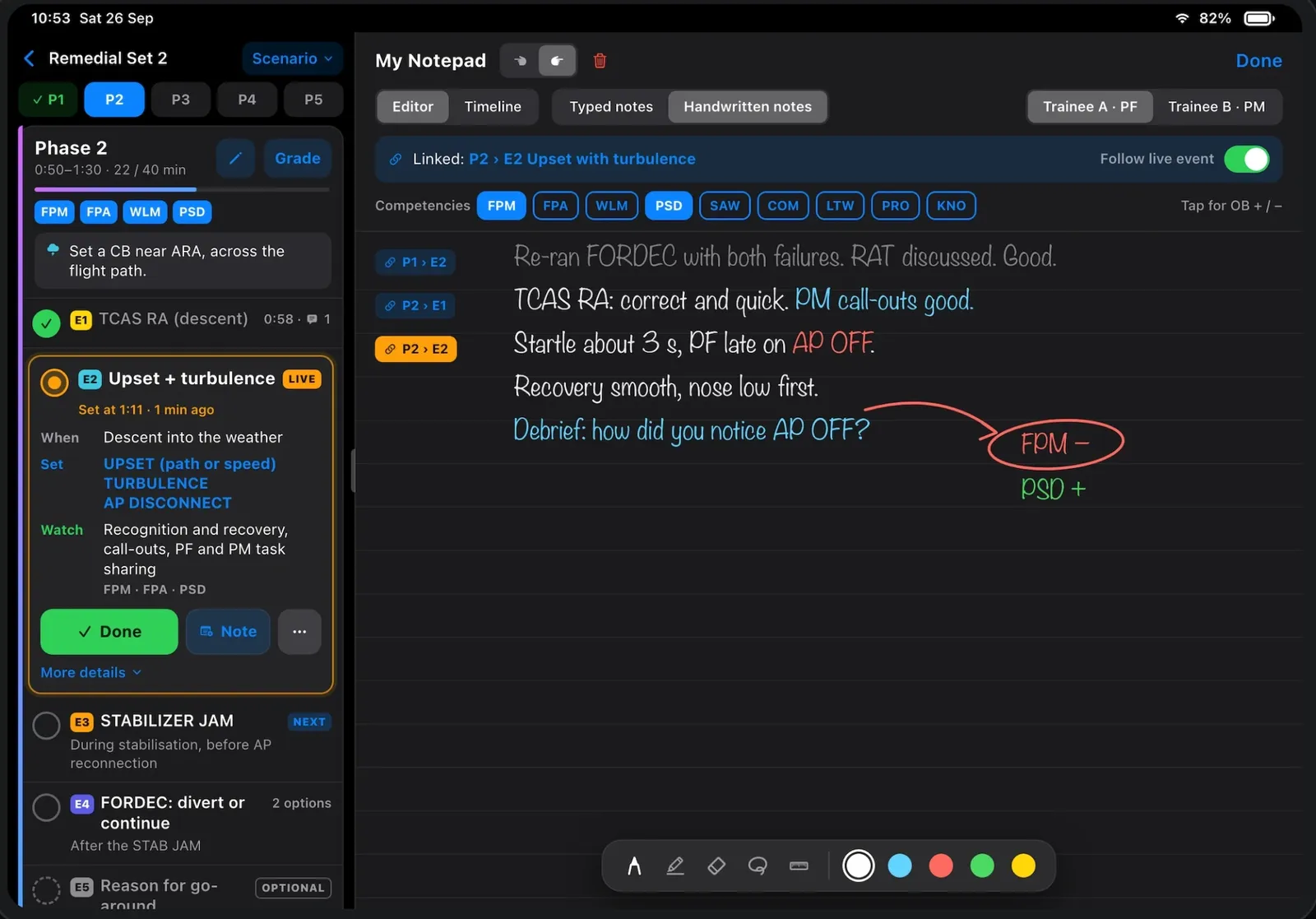
aeroEBT runs both on one record: EBT for the airline's pilots, and CBTA set up per role for everyone else.
aeroEBT, the EBT and CBTA software
Which applies to you
Start from your organisation. The page that carries the detail for each.
Airline
EBT for recurrent pilot training, and CBTA for the other training you run.
Learn moreFlight school or ATO
CBTA from the first lesson. EBT comes later, at the airline.
Learn moreCabin crew training
CBTA, with the cabin crew's own competencies and grading scale.
Learn moreAir traffic control unit
CBTA for unit, on-the-job and continuation training.
Learn moreMaintenance training organisation
CBTA assessed at the aircraft, in the terms of ICAO Doc 10098.
Learn moreThe two explained separately
What is EBT, and what is CBTA, each on its own page.
Learn more
Questions about EBT and CBTA
Are EBT and CBTA the same thing?
No, but they are not alternatives either. CBTA is the method of building training around competencies. EBT is that method applied to the recurrent simulator training of airline pilots, with the training topics taken from operational data.
Is EBT part of CBTA?
Yes. An EBT programme is a competency-based training and assessment programme. It adds two things: training topics derived from data for each aircraft generation, and a defined module of evaluation, manoeuvres training and scenario-based training.
Can an operator do CBTA without EBT?
Yes. A flight school, a cabin crew training department, an air traffic control unit or a maintenance training organisation can run CBTA with no EBT programme. An airline can also use CBTA in training that is outside its EBT programme.
Which ICAO documents cover EBT and CBTA?
ICAO Doc 9868, PANS-TRG, for competency-based training and assessment, and ICAO Doc 9995, the Manual of Evidence-based Training, for EBT.
Do instructors need different skills for each?
The core skill is the same: observe, record, classify and assess, then debrief on the root cause. What differs is the competency model and the setting.
Can one system hold both?
Yes. aeroEBT, from SkyDynamics, holds EBT for pilots and CBTA for cabin crew, air traffic controllers and maintenance training in one record, each with its own competencies, behaviours, grading scale and forms.
One record for EBT and CBTA.
A 30-minute demo covers how aeroEBT is set up for your roles, and what your authority can be shown from it.
We respond within one business day.