
aeroEBT for Aircraft Maintenance Training Organisations
Competence, assessed at the aircraft. CBTA for Part-147, Part-66 and Part-145 training, recorded as evidence an auditor can follow.
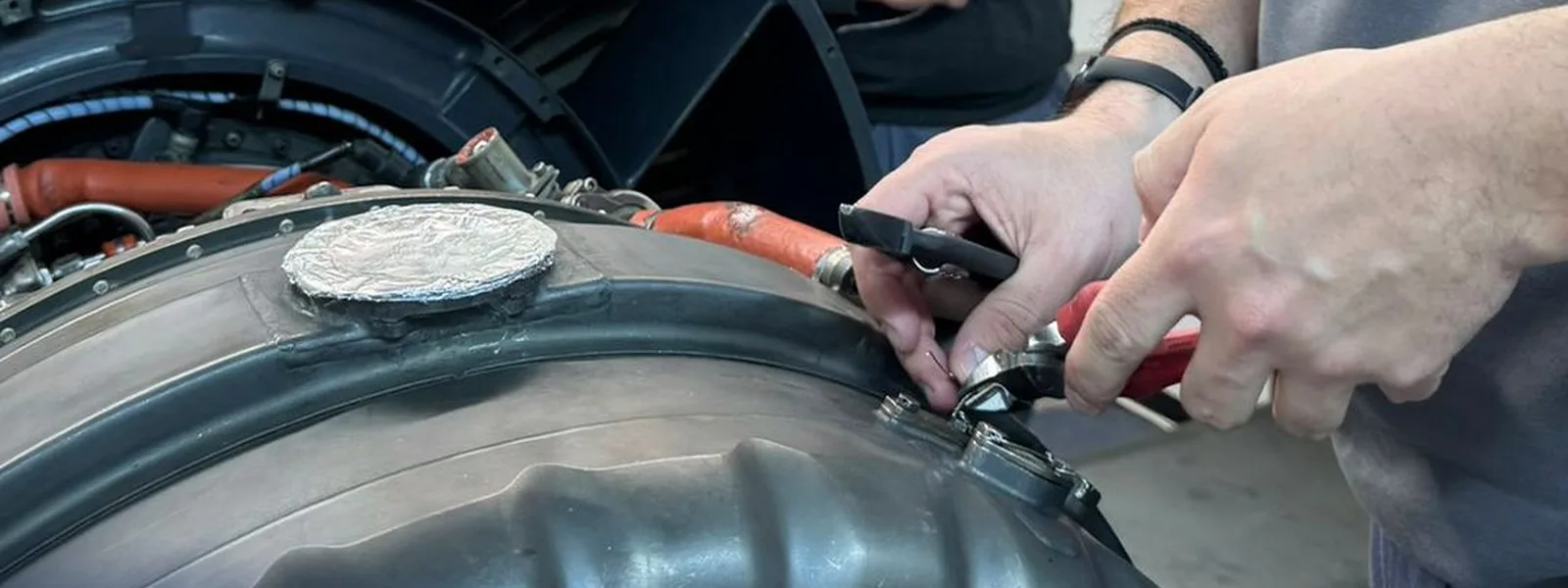
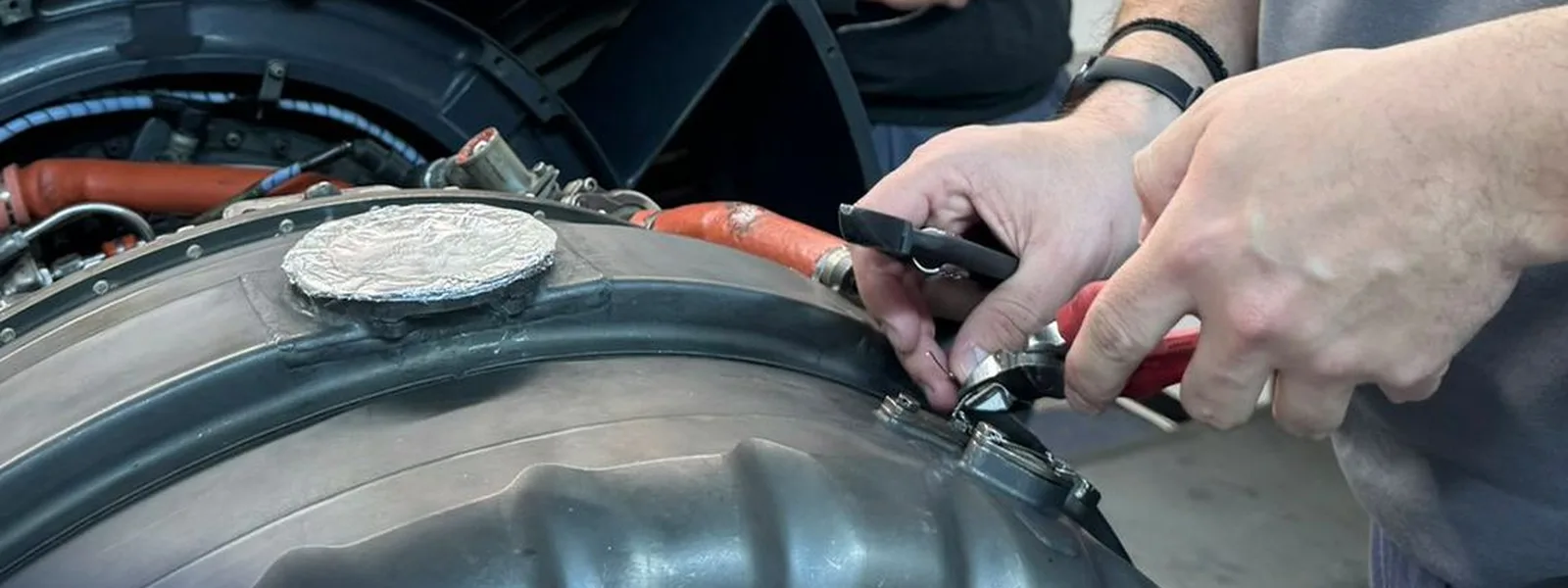
Each role, from assistant mechanic to licensed engineer, is trained and assessed against its own adapted competency model (ACM): observable competence rather than attendance. Practical assessment is recorded on a tablet at the aircraft and lands in the engineer's logbook.
A justified method. EBT and CBTA for maintenance training, made simple for instructors.
By EBT and CBTA for maintenance we mean the method: competency-based assessment with recorded evidence, applied to Part-147, Part-66 and Part-145 training. Evidence-Based Training as defined in ORO.FC.231 applies to flight crew, and we will not tell you that it is a maintenance obligation.
A justified methodology
Every competence, task and grade traces back to why it is trained and assessed, so the programme can be explained to students, assessors and your authority.
Simple for the instructor
Advanced software underneath, a short and familiar workflow on top: observe the task, record it on the tablet, assess against the standard, debrief.
Built with Olympic Air MTO
Developed in cooperation with Olympic Air MTO, with practical examples and data for assistant mechanic roles taken from real training.
Use case
Tested on real maintenance tasks. CBTA for assistant mechanics, with Olympic Air MTO.
The method on this page was tested with Olympic Air MTO, an aircraft maintenance training organisation, for its assistant mechanic programme: the adapted competency model, the KSAs and observable behaviours of each task, the threat and error scenarios, and the formative and summative assessments.
The programme, its data and its results belong to Olympic Air MTO and are shared on request. To find out more, contact Olympic Air MTO or SkyDynamics.

Adapted competency model
One framework. A competency model adapted to every maintenance role.
An adapted competency model (ACM) is the set of competencies, observable behaviours and performance levels an organisation selects for one role. It is the term ICAO uses for competency-based training and assessment (CBTA), and its manual for aircraft maintenance personnel, Doc 10098, assesses trainees against it. An assistant mechanic is not observed on the same behaviours, or held to the same level, as a B1 engineer. aeroEBT keeps one model per role, and every task, assessment and logbook entry for that role follows it.
The competency framework
The framework has 11 competency areas, each described by observable behaviours. Every role draws on the same list.
- ProceduresFocus
- Work managementIn the model
- Situational awarenessFocus
- Technical expertiseNot in this model
- System thinkingNot in this model
- Coordination and handoverIn the model
- Risk managementNot in this model
- TeamworkIn the model
- Problem solving and decision makingNot in this model
- Self-managementIn the model
- CommunicationIn the model
Assistant mechanic
An entry role, working under supervision. Often filled by people who bring a technical background from another industry.
- Competency areas in the model
- 7 of 11
- Carry the most weight
- Procedures · Situational awareness
- Target levels
- Level 3 as the base, level 4 where a behaviour is safety-critical
- Assessed on
- Frequent base maintenance tasks, carried out on the aircraft
Follows the assistant mechanic programme tested with Olympic Air MTO.
Assistant mechanic: 7 of 11 competency areas in the model, with the most weight on Procedures and Situational awareness.
What the model holds for a role
A selection of competencies
Not every competency or behaviour applies to every role. The model keeps the ones the role is observed on.
Levels written for the role
Each observable behaviour has four performance levels, described in the words of that role, so two assessors read the same standard.
A target for every task
Each task sets the level a behaviour must reach: a base level, raised where the behaviour is safety-critical.
Illustrative. The assistant mechanic model follows a programme developed with a European maintenance training organisation. The Category A and B1 and B2 models are examples of how the same framework is adapted: your organisation defines its own competencies, behaviours and target levels.
Observe, record, classify, assess
Light for the instructor. Precise for the CBTA programme, from the first task to the final assessment.
Every maintenance task carries its own knowledge, skills and attitudes (KSA). Some are mapped to an observable behaviour in the role's competency model, and some stand on their own. During the task the instructor only watches and writes short comments. AeroBrain suggests the observable behaviours each comment evidences, the instructor confirms them, and each behaviour leads to its competency. These are the ORCA steps airlines use for pilot EBT, applied in the hangar, in formative and summative assessments alike.
Task: Wheel and tyre check
Observe
The knowledge, skills and attitudes the task calls for. Each is mapped to an observable behaviour, or not.
Knows the procedure and the order of its steps
KnowledgeMapped to the behaviour: Correct procedure
Knows how tyre pressure changes with temperature
KnowledgeNot mapped: checked by a question
Reads the pressure table and applies the right limit
SkillMapped to the behaviour: Use of documents
Leaves the wheel bay clear, with every cap refitted
SkillMapped to the behaviour: Work area inspection
Stops and reports when a finding is outside the limits
AttitudeMapped to the behaviour: Reporting deviations
Takes care over the standard of the work
AttitudeNot mapped: discussed in the debrief
Record
Short comments while the trainee works. Nothing is graded yet.
Select a comment to follow it to the behaviours it evidences.
Classify
AeroBrain suggests the behaviours each comment evidences. The instructor confirms or changes them.
Uses the task documents properly
ProceduresConfirmed
Selects the correct procedure for the task
ProceduresConfirmed
Assesses the situation and reports deviations
Situational awarenessConfirmed
Inspects the work area after the task
Work managementConfirmed
Assess
A level against the target for each behaviour, under its competency.
Procedures2 of 2 at target
Correct procedure
Level 3, target 3: At target
Use of documents
Level 4, target 4, safety-critical: At target
Situational awareness1 of 1 at target
Reporting deviations
Level 4, target 4, safety-critical: At target
Work management0 of 1 at target
Work area inspection
Level 2, target 3: Development point
Formative: the same KSAs and behaviours, used for feedback. A behaviour below its target becomes a development point for the next task.
Illustrative task, comments and levels. Suggestions are advisory: the instructor decides every classification and every level before a training record is signed.
After the task, the same cycle carries on
Debrief
The conversation that turns a mistake into learning, recorded rather than remembered.
Report
Student record, course report and authority evidence from the same data.
Calibrate
Assessor consistency measured: two assessors, one task, one standard.
A worked example: the assistant mechanic programme
Three training events. From the classroom to assessed tasks on the aircraft.
Competence is built in steps, and the adapted competency model decides what is observed at each one. This is how a CBTA programme for assistant mechanics runs in a Part-145 organisation.
Classroom and aircraft visits
Knowledge first: classroom instruction and visits to the aircraft, assessed by written examination. No competency is graded at this stage.
Observed in the workshop
The trainee takes part in practical work while the instructor observes the competencies on a smaller scale. The outcome is formative: strengths and areas to improve, not a pass or a fail.
Assessed on the aircraft
Tasks come from base maintenance work packages, chosen for how often they occur and how much they matter to the operation, not for their complexity. Every behaviour in the model is trained, and procedures and situational awareness carry the most weight.
Task assessment
Behind every assessment. Target levels, threat and error scenarios, and a result built over several tasks.
A target level for every behaviour
Each behaviour is rated on four performance levels: beginning, developing, approaching and proficient. The task sets the target: level 3 as the base, level 4 where the behaviour is safety-critical. A performance level is not a grade.
Threats and errors, as scenarios
Each task carries a pool of threat and error scenarios the instructor can introduce: time pressure before a departure, an interrupted task, an ambiguous reading. The trainee is observed managing the threat before it becomes an error.
Several tasks, one result
No single task proves a competency. Several tasks are set side by side, like the circles of a Venn diagram: the behaviours every task shares show consistency, and all the behaviours together show breadth.
Learn moreThe Contextual Composition Protocol
The instructor writes a short comment. The protocol, a technology developed by SkyDynamics, holds the role's competency model, the task and its KSAs and the target levels in memory, so the app knows which trainee, task and behaviours the comment belongs to. It never decides a level or a result: the instructor does.
Learn moreFeedback the trainee keeps
The tasks performed, the level reached on each behaviour and the assessor's comments are written to the engineer's logbook, next to task experience and authorisations. The engineer keeps a copy, like a pilot's logbook.
Learn moreConfigured to your organisation
The scheme shown on this page is an example. Competencies, target levels and pass rules are set to your own competence standard.
Evidence
The record an audit asks for. Part-147 basic training, type training and Part-145 continuation training, in one system.
Practical assessment records are where maintenance training audits get uncomfortable: signatures on forms, tasks recorded inconsistently, and evidence spread between the hangar and the training office. Captured in the same system as the theory, the record is complete by the time the task is finished.
Who assessed, and were they qualified
Assessor identity and qualification recorded alongside the assessment, with the date, not looked up afterwards.
What was actually performed
The task list with evidence per task, rather than a signature covering a module. Progress against the required list is visible to the student and the training manager, so gaps show before the course ends.
Traceability to the syllabus
Every assessment tied to the Part-147 module, type training element or company requirement it satisfies.
Training that answers a finding
When an occurrence report points at a task, Part-145 continuation and human factors training for it is planned, delivered and assessed against the same standard, and the record shows it.
Consistency between assessors
Measured, so "our assessors agree" is a statement with data behind it.
Records that survive people leaving
The record belongs to the organisation, not to an instructor's filing habits.
Your path
Four steps to start. From your competence standard to the audit trail.
Configure your standard
Your competence standard, task lists and scale: Part-147 basic, type and continuation training.
Assess at the aircraft
Practical assessment captured offline where the task is performed.
Give engineers a logbook
Task experience, training and authorisations in one record the engineer keeps.
Learn moreKeep the audit trail
Assessor, date and evidence on every task, held in Swiss data centres and exportable whenever you ask.
Learn more
Questions maintenance training organisations ask
Is EBT required for maintenance training?
No. Evidence-Based Training under ORO.FC.231 applies to flight crew. What we offer here is competency-based assessment with recorded evidence, applied to Part-147, Part-66 and Part-145 training, which is a method rather than an obligation.
What is an adapted competency model (ACM)?
An adapted competency model is the group of competencies, with their observable behaviours and performance criteria, that an organisation adapts from a competency framework for one specific role. The term comes from the ICAO provisions on competency-based training and assessment (PANS-TRG, Doc 9868), and ICAO Doc 10098 applies them to aircraft maintenance personnel. In aeroEBT each role, for example assistant mechanic, Category A mechanic or B1 and B2 engineer, has its own model.
Is it an adapted or an adaptive competency model?
The ICAO term is adapted competency model: a model adapted to a role. It is sometimes written as adaptive competency model. Both refer to the same thing, and ACM is the usual abbreviation.
Can an assistant mechanic without a licence be trained with CBTA?
Yes. Competency-based training and assessment does not depend on the licence category. For an assistant mechanic the model keeps the competencies the role is observed on, describes the performance levels in the words of that role, and raises the target where a behaviour is safety-critical.
Is a performance level the same as a grade?
No. A performance level describes how well one observable behaviour was shown on one task. The grade is the decision for the whole assessment event, taken over several tasks from how many behaviours reached their target and how consistently they were shown.
What does ORCA mean in maintenance training?
ORCA stands for observe, record, classify, assess. The instructor observes the task, records short comments for each trainee, classifies each comment to the observable behaviours it evidences, and assesses each behaviour against its target level. It is the same process airlines use for pilot EBT, applied to maintenance tasks.
Does every KSA have to be linked to an observable behaviour?
No. Each task lists the knowledge, skills and attitudes (KSA) it calls for. Many are mapped to an observable behaviour and are assessed through it. Others stand on their own, for example a knowledge point checked by a question or an attitude discussed in the debrief.
Does AI grade the trainee?
No. AeroBrain can read the instructor's comments and suggest the observable behaviours they evidence. The suggestions are advisory: the instructor confirms or changes each one and decides every performance level before a training record is signed.
Does this replace our examination system?
No. Examinations remain what your approval requires. This is about the practical assessment and the competence record around them.
Does it work offline in a hangar?
Yes. Assessments are captured offline at the aircraft and synchronise when the device reconnects.
Does training show up in the engineer logbook?
Yes. Basic, type and continuation training and every practical assessment are written to the engineer's digital logbook alongside their task experience and authorisations. The engineer keeps a copy; the organisation keeps its record.
Can we use our own competence standard?
Yes. The framework and scale are configured to your organisation, exactly as for a flight crew programme.
How does it relate to the technical log?
They are separate records. AeroTechLog covers defects and airworthiness; this covers training and competence. Where an organisation runs both, the picture of who is qualified for what is easier to keep straight.
Not your organisation?
The version written for you
Airlines
Recurrent training on mixed or baseline EBT, cadet programmes and type rating.
Learn moreFlight schools & ATOs
CBTA for flight schools from the first lesson to MCC, with FSMS integrated to run the school, the fleet, maintenance and financials.
Learn moreFSMS
CBTA for flight schools, with flight school management integrated.
Learn more
Bring the practical record in from the paper.
Thirty minutes on your training organisation: what you record today, what an audit would ask for, and what changes if the practical assessment is captured at the aircraft.
We respond within one business day.