

For Heads of Training and Nominated Persons Crew Training
EBT software for Heads of Training. You own the programme, the standard and the evidence.
Three things tend to be true at once: instructors grade differently, the programme has drifted since approval, and the evidence for the next audit is scattered. aeroEBT is built for the person accountable for all three.

The job
What actually fills your week. Instructors, evidence and the programme.
Instructors
Standardisation, availability, development and the awkward conversation about grading.
Evidence
Records for the authority, the safety department and the accountable manager, usually assembled by hand.
The programme
Keeping it current, approved and actually delivering the competencies it claims.
Where EBT programmes break
Three problems you recognise. Drift, concordance and evidence.
They tend to be true at once, and none of them is anyone's decision.
Drift
Within two to three years, many programmes slide back from training to checking. Nobody decides it; it just happens.
Concordance
Two instructors, one crew, two different grades. Without measuring it, your training data is partly noise.
Evidence
The data exists, but the story your authority asks for (what you saw, what you changed, what improved) takes weeks to assemble.
aeroEBT runs the full ORCA cycle, and standardisation is monitored underneath it.
How aeroEBT keeps a programme from driftingWhat changes
Six things you get back. When the programme runs in one system.
One system
One version of the grading standard
Every base and every instructor works from the same framework and scale.
Drift becomes visible
Distribution per instructor and per competency against the fleet baseline, every month rather than every year.
The debrief is captured
Observations from instructor notes, so the narrative survives the session.
Evidence on demand
The audit pack comes from live data instead of a manual assembly before every audit.
Instructors stop fighting the tool
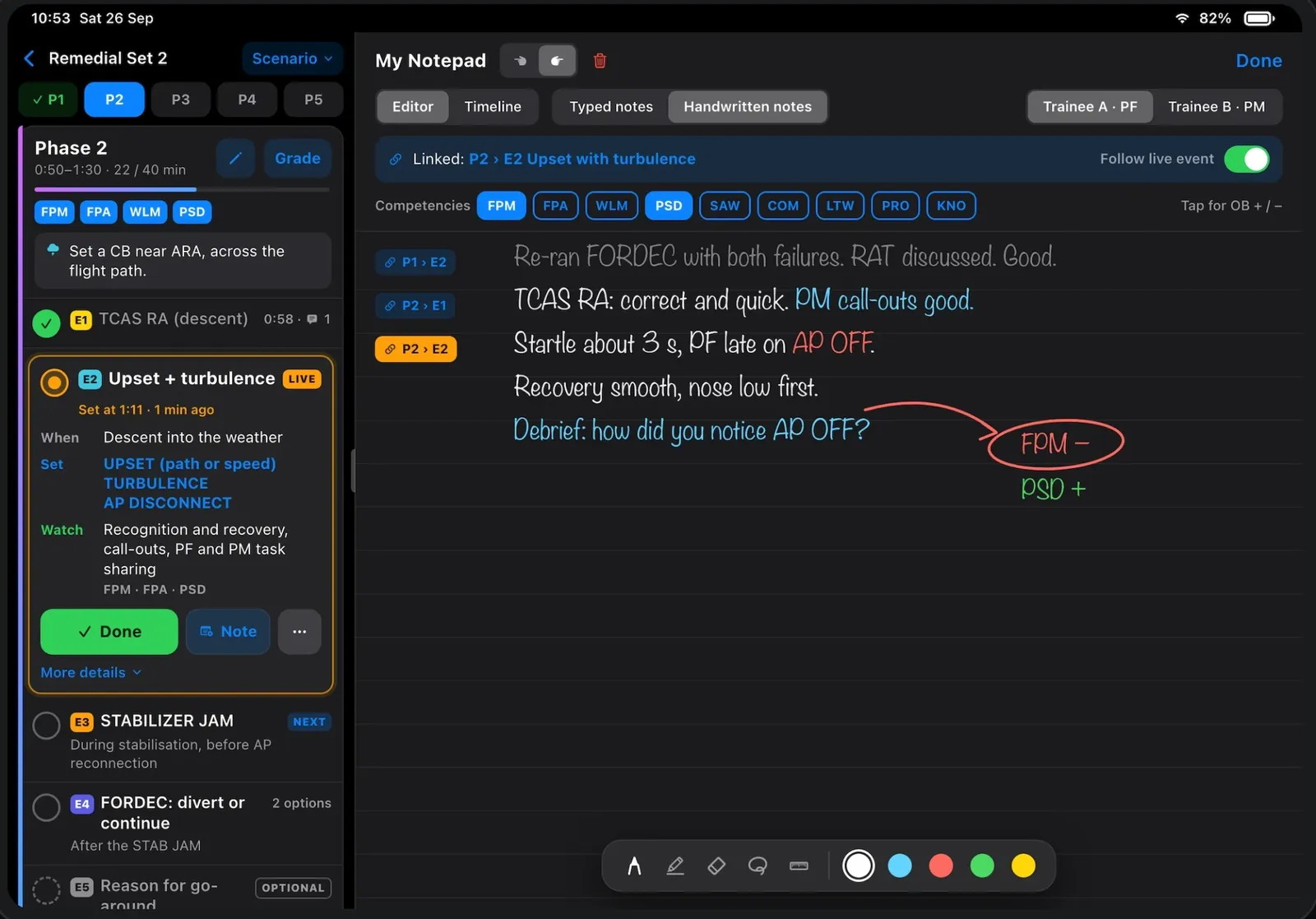
Grading in the simulator, offline, in three taps or fewer, with one procedure to follow.
You can prove what you changed
Which is the question an inspector asks after "what did you find?".
aeroEBT gives instructors one practical procedure: open the session, grade, debrief. Everything else assembles itself underneath.
See what it asks of your peopleTraining standards
See who grades differently. And where to calibrate.
aeroEBT shows each instructor's grade distribution against your fleet baseline, from the grades instructors already enter, so your training standards team can target calibration where it matters instead of re-briefing everyone.
- Grading drift per instructor against the fleet baseline
- Calibration sessions planned and recorded in the same system
- Grading can be reopened and corrected with a full audit trail
Evidence
The audit pack, from live data. Not assembled by hand before every audit.
The pilot record and the authority pack come from the recorded sessions themselves: what you saw, what you changed and what improved, in the sequence an inspector asks for.
- Evidence compiled directly from the recorded sessions
- Competency trends across the programme
- What the programme changed in response, shown with the data behind it
- Exportable whenever it is asked for
Implementation
Your first 90 days. From mapping your programme to go-live.
A typical rollout. Timings are agreed with you after the demo.
Week 13 of 13: Go live
Your team
What each role sees. Four roles, one record.
Instructors
An iPad app that works in the simulator, offline, with the debrief captured as they go.
- Offline in the simulator
- One procedure: open, grade, debrief
- Debrief notes captured
- Signatures and PDF records
Training standards
Concordance, competency trends and calibration in one view.
- Concordance per instructor
- Competency trends
- Calibration planned and recorded
- Fleet and base view
Training administration
Qualifications, expiries and scheduling linked to the grading record through TMS.
- Qualifications
- Expiries
- Scheduling
- One record with the grading
Accountable Manager
Cost per pilot and per simulator hour, and the state of compliance without asking you for a report.
- Cost per pilot
- Cost per simulator hour
- State of compliance
For the Accountable Manager
What the programme costs. And what it delivers.
Cost visibility
Training spend per pilot, per course and per simulator hour, so utilisation decisions rest on data.
One standard across bases
Every base, instructor and fleet grades to the same framework and scale.
Audit-ready records
Records for your authority, always current: no scramble before an inspection.
Early warning
Competency trends across the pilot population, visible before they reach the line.
Questions Heads of Training ask first
Will my instructors accept it?
They accept tools that make the session easier and reject tools that add admin. Grading happens in the simulator, offline, in three taps, and the debrief notes they already write become the evidence.
Do we have to change our grading scale?
No. Your framework and scale are configured into the system during the first weeks.
What happens to our historical records?
They are imported and stay with the pilot, so the competency history is not broken by the change of system.
How much of my time does implementation take?
The programme mapping in weeks 1 and 2 needs you. The rest is mostly your administrator, your standards team and us.
What if we are mid-approval with our authority?
Tell your authority before you change how records are kept. The programme under approval stays the same; what changes is where grades and evidence are recorded and how the evidence is produced. The parallel run lets you show both side by side before you switch.
Who owns the records, and can we take them with us?
Your organisation does. Training records and competency data are held in data centres in Switzerland and can be exported in a structured form at any time, and an on-premises deployment is available. The Trust centre sets out where the data is processed and who can reach it.
Talk to our training team.
Thirty minutes on your programme: where it drifts, what your evidence looks like today and what the first 90 days would involve.
We respond within one business day.