
Training Management System
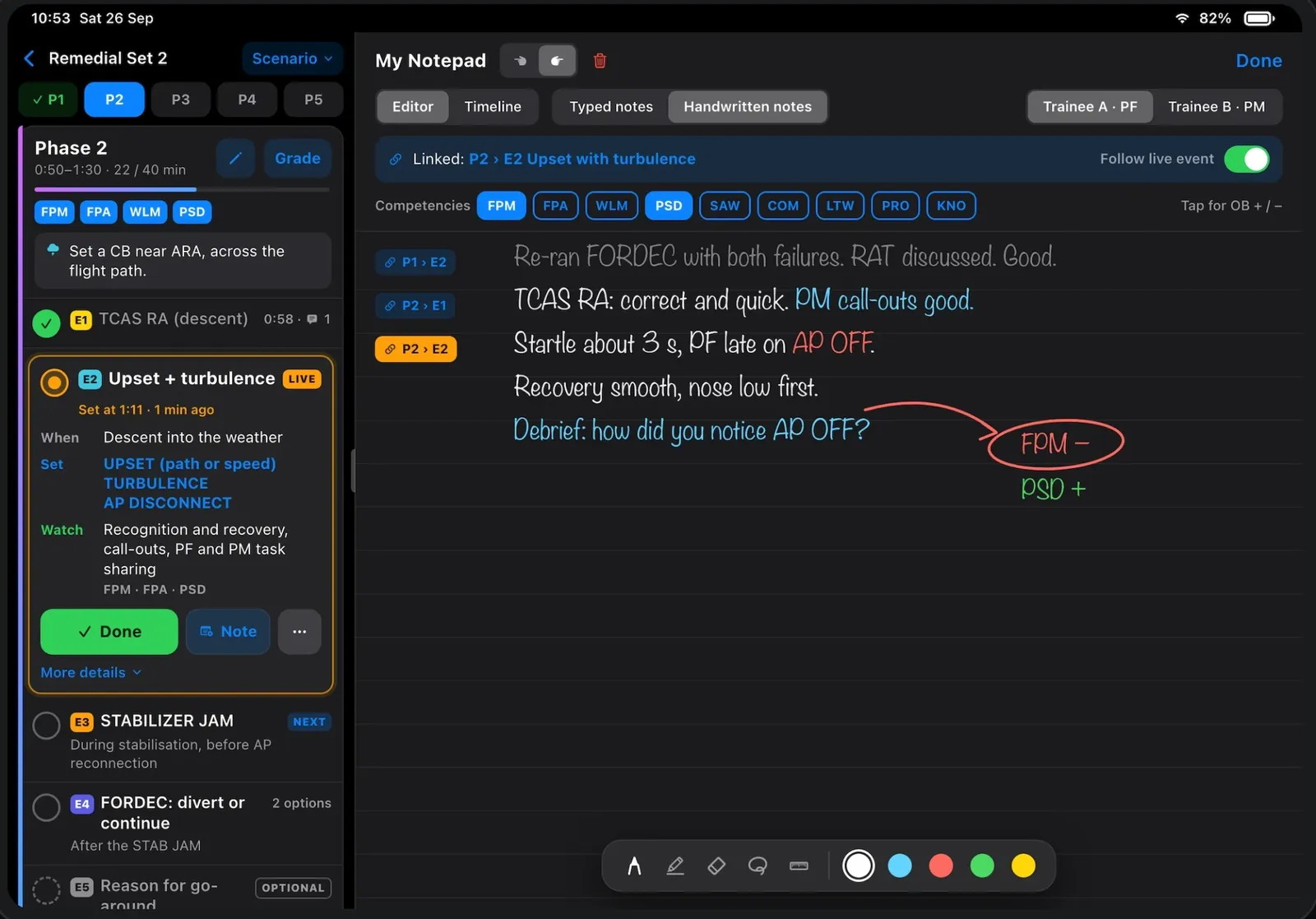
Airline training management system. The training office in one record: qualifications, courses, devices and cost, joined to EBT grading.
The SkyDynamics Training Management System (TMS) for an airline training department: pilots, cabin crew, maintenance staff and ground personnel in one record with the competency grading in aeroEBT. Agents propose; a person approves every change.

Choose your organisation
One Training Management System. Three kinds of training organisation.
This page is written for the airline training office. Flight schools and maintenance training organisations have their own pages: start where you sit.
Airline
Qualifications, courses, documents, contracts and cost for every crew and staff role, joined to EBT grading in aeroEBT.
Go to the airline section
Flight School
Aircraft and FNPT II simulator fleet, scheduling, students and financials per client or per trainee, for ATOs from PPL to MPL.
Go to the flight school section
Aircraft Maintenance Training Organisation
Competency-based assessment for Part-147 and Part-66 training, one maintenance task taught and then assessed, and the training and practical logbooks.
Go to the MTO section
What is the SkyDynamics Training Management System?
The SkyDynamics Training Management System (TMS) is the training office of an airline in one record: qualifications and expiries, courses and e-learning, documents, planning, contracts and cost, for pilots, cabin crew, maintenance staff and ground personnel. It shares that record with aeroEBT, so the competency grading and the administration behind it are one file.
Agents do the repetitive work: they draft the plan, chase what expires and prepare the paperwork. They propose; a person approves. Nothing in a person's record, a contract or a booking changes without that approval.
How we know
Methodology and evidence. One record with grading and simulator qualification.
The SkyDynamics TMS is the airline training office on the same data as aeroEBT grading and FCS++ device records. The modules below are described on this page; customer rollout times and named HR or rostering integrations are not published here unless listed under Connected.
Shared record with aeroEBT
Competency grading, scenario design and instructor concordance in aeroEBT read and write the same pilot and programme record as qualifications, courses, documents, contracts and training finance in TMS.
FCS++ and training on qualified devices
FCS++ holds each simulator's FSTD Capability Signature and qualification evidence. EBT sessions can be scheduled on devices that can credit them when FCS++ is connected to the training programme.
Agentic operation under approval
Agents may propose schedule changes, flag expiries or prepare paperwork. Nothing changes in the record until a person approves it, as stated in the Agents section of this page.
Regulatory context for EBT programmes
EBT programme rules and scenario requirements are implemented in aeroEBT against EASA ORO.FC.231 and ORO.FC.232 and ICAO Doc 9995. TMS carries the training administration evidence that surrounds those sessions.
For airlines
The airline training office. Eight modules on the same data.
LMS e-Learning
Learning management with course creation, delivery and tracking. SCORM compliant, with multimedia support.
- Course Builder
- Progress Tracking
- Assessments
- Certificates
Qualifications
Crew qualifications, certifications and currencies tracked in one place, with automated expiry notifications and renewal workflows.
- Qualification Tracking
- Expiry Alerts
- Renewal Workflows
- Compliance Reports
DMS Documents
Document management with version control, access permissions and audit trails. All training materials in one place.
- Version Control
- Access Control
- Audit Trails
- Search & Filter
Analytics
Reporting and dashboards across programmes, fleets and bases, including EBT, CBTA and AQP metrics read next to qualification and course data.
- Custom Reports
- Real-Time Dashboards
- Trend Analysis
- Export Options
Planning & Scheduling
Instructors, trainees, aircraft and simulators scheduled together, with rules, forecasting and what-if planning before a cycle is committed.
- Resource Planning
- Rules & Automation
- Forecasting
- Scenario Planning
Training Design
Build and revise syllabi for ab initio, type rating, recurrent, line checks, command courses and classroom or e-learning, with a compliance matrix against EASA, your authority and your approval.
- Syllabus Builder
- Compliance Matrix
- Versioning
- Authority Exports
Contract Management
Training agreements, bonding, provider and simulator contracts held with their terms, rates, renewal dates and consumption against what was committed.
- Agreements
- Bonding
- Renewals
- Commitment Tracking
Financial Management
Budget against actual by programme, fleet and base: simulator hours, instructor cost, courses and recharges, with invoices and provider billing reconciled.
- Budget vs Actual
- Cost per Pilot
- Invoicing
- Recharges
Agentic operation
Agents propose. A person approves.
Not a chatbot bolted onto a database. Agents carry out the repetitive work of a training office and leave the decision with a person. What may an agent change without approval? Nothing.
Build the plan
Draft the training cycle against due dates, device availability, instructor qualification and crew rosters, and rebuild it when something moves.
Chase what expires
Notice an approaching expiry, propose the slot, notify the crew member and follow up when nothing happens.
Prepare the paperwork
Assemble course reports, authority exports and audit packs from live data, ready for a human to check and sign.
Watch the money
Flag a programme drifting over budget, an under-used device or a contract approaching its committed volume.
Ask before acting
Every agent action that touches a person's record, a contract or a booking is proposed for approval, logged, and reversible.
Leave judgement to you
Agents remove the administration. Who trains, when and to what standard remains a training manager's decision.
Who it covers
Not only the flight deck. Cabin crew, maintenance staff and ground personnel too.
One training record for every licensed and approved role in the operation, instead of a separate system per department.
Flight crew
Type ratings, recurrent, line checks and command upgrade, with EBT grading in the same record.
Cabin crew
Initial, recurrent, aircraft differences and safety and emergency procedures training.
Maintenance staff
Part-147 and Part-66 training and Part-145 continuation training, with practical assessment.
Learn moreGround personnel
Dangerous goods, ground operations and company-required training with the same expiry tracking.
Connected
One record with aeroEBT. Other systems through the API.
Training does not sit alone: rosters, crew records and flight operations all touch it.
aeroEBT
Competency grading and the training record in one file rather than two systems.
FCS++
Device capability visible when a session is scheduled, so a lesson lands on a device that can credit it.
Crew management and rostering
Training windows and due dates aligned with published crew rosters.
Flight operations systems
Scheduling and crew data exchanged with the operations systems you already use, through the API.
For flight schools and ATOs
A flight school runs on FSMS. Fleet, schedule and financials for Part-FCL courses from PPL to MPL.
FSMS, the Flight School Management System, is the same platform written for an ATO. It has its own page; in three points:
Aircraft and FNPT II simulators
Every aircraft and every flight simulation training device (FSTD) has its own record, and the schedule reads it before a lesson is booked.
Learn moreThe school day
Lessons, FNPT II (FNPT 2) sessions and ground school in one schedule, with a due check or a grounding squawk caught at booking.
Learn moreFinancials per client and per trainee
Sponsored cadets roll up to their airline; self-funded students get their own account, packages and invoices.
Learn more
For maintenance training organisations
Maintenance training has its own pages. Part-147, Part-66 and the engineer logbook.
For maintenance, EBT and CBTA mean the method: competency-based assessment with recorded evidence. Evidence-Based Training under ORO.FC.231 applies to flight crew.
Competency-based assessment
Competency frameworks, assessment schemes and reports for Part-147 and Part-66 training, built on knowledge, skills and attitudes with observable behaviours.
Learn moreOne task, taught and then assessed
The same maintenance task is the teaching material in the classroom and the assessment at the aircraft, with the assessor, the date and the evidence attached.
Learn moreTraining and practical logbooks
Modules, type training and exams on one side, practical experience by task and ATA chapter on the other, written to the engineer's logbook.
Learn more
TMS: questions training managers ask
What is the SkyDynamics Training Management System?
The training office of an airline in one record: qualifications and expiries, courses and e-learning, documents, planning, contracts and cost, for pilots, cabin crew, maintenance staff and ground personnel. It shares that record with aeroEBT, where the competency grading is done.
What can an agent change without approval?
Nothing. Every agent action that touches a person's record, a contract or a booking is proposed for approval, logged, and reversible. Who trains, when and to what standard remains a training manager's decision.
How does the TMS connect to aeroEBT and to our other systems?
The TMS shares one record with aeroEBT: the competency grading and the training record are one file rather than two systems. Rostering, crew management and flight operations systems connect through the API.
Does it cover staff other than pilots?
Yes. Flight crew, cabin crew, maintenance staff and ground personnel are held in one training record with the same expiry tracking, instead of a separate system per department.
We are a flight school. Is this the right page?
Flight schools and ATOs use FSMS, the Flight School Management System, on the same platform: the aircraft and FNPT II fleet, the schedule, maintenance, students and financials per client or per trainee. FSMS has its own page.
Is EBT a requirement for maintenance training?
No. Evidence-Based Training under ORO.FC.231 applies to flight crew. For Part-147 and Part-66 training we apply the method: competency-based assessment with recorded evidence.
What is EPL?
The Electronic Personnel Licence: a licence issued electronically by the competent authority, proposed in EASA NPA 2024-08. The TMS is being prepared to hold and verify it once authorities issue it; it is on the roadmap, not live.
See your training office in one record.
A 30-minute walkthrough on your own courses, qualifications and devices: what the agents propose, and what you approve.
We respond within one business day.