
Olympic Air MTO case study
Competence, made visible. Olympic Air MTO runs CBTA for Part-66 and Part-147 maintenance training on aeroEBT.
Olympic Air MTO had applied CBTA and EBT methods to maintenance training for years. The method was tested on its assistant mechanic programme, and since February 2026 its Part-66 and Part-147 training and the management of the organisation run on aeroEBT, with competency recorded as evidence an auditor can follow.
At a glance. Olympic Air MTO and SkyDynamics.
- Organisation
- Olympic Air Maintenance Training Organization
- Training
- Part-66 and Part-147
- Programme tested
- Assistant mechanic
- With aeroEBT since
- February 2026
- In use
- aeroEBT for maintenance training, engineer logbook, aeroEBT for MTOs
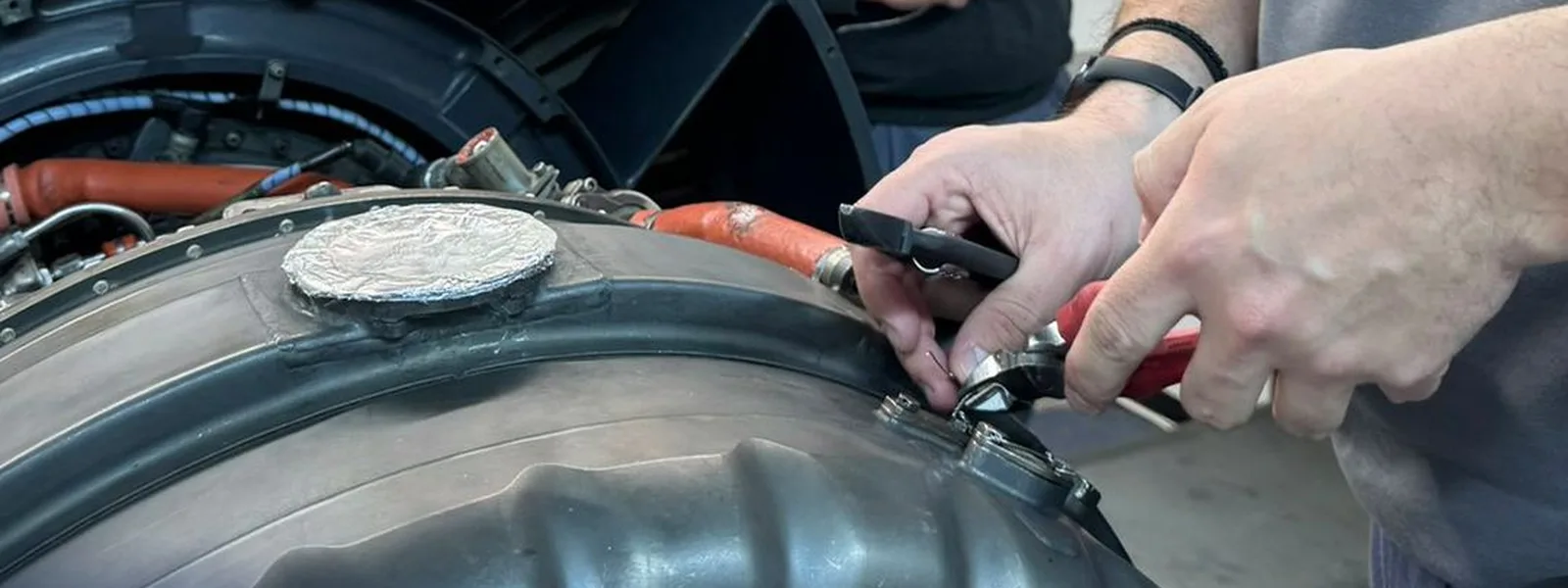
Published 16 October 2026 by Manolis Lidakis. Photo: Olympic Air MTO. Olympic Air MTO (opens in a new tab)
Years of method. Competency-based maintenance training that needed a tool to show it.
Olympic Air Maintenance Training Organization had worked with competency-based training and assessment (CBTA) and evidence-based methods in Part-66 and Part-147 training for years: the ORCA process (observe, record, classify, assess), Venn models, the knowledge, skills and attitudes (KSA) of each task and the observable behaviours that show them.
One of the hardest things in maintenance training is to prove that competency is being built, and where. The method lived in the work of the organisation's experts, Mr Oikonomou, who leads the programme, and Mr Papamichalis. It needed a tool that keeps the method intact, keeps it light for the instructor at the aircraft, and turns every assessment into a record.
Tested on real tasks. An assistant mechanic programme first, then the whole organisation.
The method was tested with Olympic Air MTO on its assistant mechanic programme: an adapted competency model for the role, the KSAs and observable behaviours of each task, a pool of threat and error scenarios, and formative and summative assessments across classroom, workshop and aircraft tasks.
At the aircraft the instructor observes the task and writes a short comment. AeroBrain suggests the observable behaviours the comment evidences, and the instructor confirms or changes each one. The Contextual Composition Protocol holds the role's competency model, the task, the target levels and the trainee in memory, so the complex part of the programme stays behind the screen. Every assessment is written to the engineer's digital logbook.
In February 2026 Olympic Air MTO came on board with aeroEBT for its Part-66 and Part-147 training, and entrusted the management of the organisation to aeroEBT for MTOs: one tool for the training record and the running of the organisation.
Task: Wheel and tyre check
Observe
The knowledge, skills and attitudes the task calls for. Each is mapped to an observable behaviour, or not.
Knows the procedure and the order of its steps
KnowledgeMapped to the behaviour: Correct procedure
Knows how tyre pressure changes with temperature
KnowledgeNot mapped: checked by a question
Reads the pressure table and applies the right limit
SkillMapped to the behaviour: Use of documents
Leaves the wheel bay clear, with every cap refitted
SkillMapped to the behaviour: Work area inspection
Stops and reports when a finding is outside the limits
AttitudeMapped to the behaviour: Reporting deviations
Takes care over the standard of the work
AttitudeNot mapped: discussed in the debrief
Record
Short comments while the trainee works. Nothing is graded yet.
Select a comment to follow it to the behaviours it evidences.
Classify
AeroBrain suggests the behaviours each comment evidences. The instructor confirms or changes them.
Uses the task documents properly
ProceduresConfirmed
Selects the correct procedure for the task
ProceduresConfirmed
Assesses the situation and reports deviations
Situational awarenessConfirmed
Inspects the work area after the task
Work managementConfirmed
Assess
A level against the target for each behaviour, under its competency.
Procedures2 of 2 at target
Correct procedure
Level 3, target 3: At target
Use of documents
Level 4, target 4, safety-critical: At target
Situational awareness1 of 1 at target
Reporting deviations
Level 4, target 4, safety-critical: At target
Work management0 of 1 at target
Work area inspection
Level 2, target 3: Development point
Formative: the same KSAs and behaviours, used for feedback. A behaviour below its target becomes a development point for the next task.
Illustrative task, comments and levels. Suggestions are advisory: the instructor decides every classification and every level before a training record is signed.
Outcomes. Each one with its source.
The CBTA method tested on a real assistant mechanic programme, from the competency model to the summative assessment
Source: SkyDynamics, owner statement (CEO), 2 October 2026. Note: the programme, its data and its results belong to Olympic Air MTO and are shared on request.
Part-66 and Part-147 training runs on aeroEBT, with competency assessed and recorded as evidence an auditor can follow
Source: Olympic Air MTO comes on board with aeroEBT, 28 February 2026.
The management of the organisation runs in the same tool, aeroEBT for MTOs
Source: Olympic Air MTO comes on board with aeroEBT, 28 February 2026.
In this study
Ask for a reference. Talk to us about what Olympic Air MTO changed.
We put you in touch with the right person and show the same workflow on your own programme.
We reply within one business day.